
Introduction
Invisalign is quicker, easier, less noticeable, and equally as effective as braces in most cases. People desire dental treatment for functional as well as esthetic reasons, and orthodontics is the perfect marriage of those two desires. When teeth come together as they should, harmony is achieved. You maximize the functionality of each individual tooth and summarily maximize the potential of your teeth as a whole, both in esthetics and purpose. With modern material science and methodology, we have a new alternative to braces for harmonizing smiles and it’s called Invisalign. Dr. Pellegrom and staff at Harbor Lights Dental Care are now offering this incredible service to current and future patients in the Grand Haven, Spring Lake, Ferrysburg, and surrounding communities.
1. How to decide if Invisalign could be useful for you
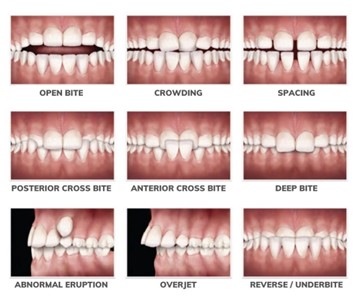
There are certain aspects of your teeth that can be served by considering orthodontics:
- Crowded teeth or gaps between teeth
- Bite problems, such as over or underbite
- Chipped or worn down front teeth
- Jaw pain
- Difficulty chewing
- Teeth grinding
- Open bite
All of these symptoms can be helped by moving the teeth into a more ideal position. With Invisalign you can push teeth apart or bring them together, shift the alignment so that your bite is even, increase the space between your upper and lower front teeth to prevent them from contacting and wearing down, shift your bite so that your jaw comes together more naturally, and subsequently reduce teeth grinding by having your jaw resting in a more comfortable position.
When teeth come together properly, they function properly, too. Having ideal tooth alignment prevents abnormal tooth wear from occurring in the future. Finding a dental professional that you can trust, like Dr. Colin Pellegrom, can give you options to achieve proper form and function for your smile.
2. Key differences between Invisalign and traditional braces
One of the biggest and most obvious differences between Invisalign and braces is that braces are fixed in position and Invisalign retainers are removeable. The fact that Invisalign is removeable means that patient compliance becomes very important. Invisalign retainers must be worn for 22 hours per day and changed every two weeks in order to work properly. If you aren’t wearing them, they aren’t working! Conversely, braces cannot be removed so patient compliance is less of an issue. Careful patient instruction and selection is necessary to have a predictable outcome with Invisalign.
Invisalign treatment is also faster than traditional braces. A typical course of Invisalign takes just 4-8 months to align your smile, whereas braces may take up to 2 years to complete. Invisalign is also more hygienic, meaning that it is easier to brush and floss your teeth with the retainers out, clean the retainers, and place them back in. To floss with traditional braces, you need to thread the floss under the wire and floss each interproximal space individually which takes much longer. So, how does it work?
3. Invisalign: under the hood
The mechanics of orthodontic tooth movement are quite complex but I can boil it down to a couple key aspects. Tooth movement is accomplished by pushing and pulling teeth one way or another, in a specific direction and with a constant force. The other aspect of orthodontic tooth movement that allows teeth to move is that the bone remodels around them. Bone is resorbed on the socket wall where the force is pushing, and bone is deposited on the wall where the tooth is pulling away. This is accomplished by specific cells and signals. Cells that take away bone are called oseteoclasts, and cells that lay down new bone are called osteoblasts. Referring to the image below, osteoclasts are active on the red (-) side and the osteoblasts are laying down new bone on the (+) side of the tooth root.
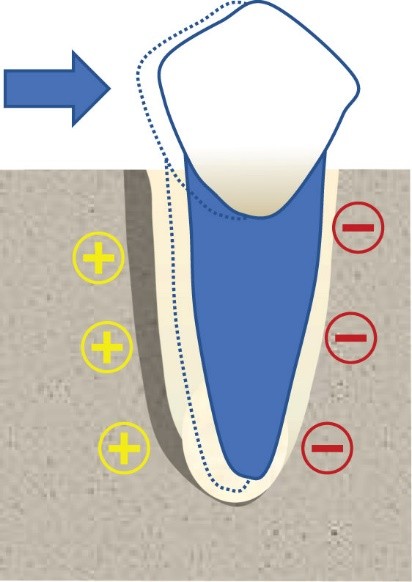
It’s important that the teeth under force move at a physiologic rate in order to prevent tooth roots from becoming reduced in size. Force that is too great on a tooth can cause the root to resorb, then the crown of the tooth may lose support and anchorage within the bone. The most dependable rate of force for achieving tooth movement and preventing root resorption is approximately 0.2 millimeters every 2 weeks. This is accomplished by the specific Invisalign tray design which is made from a BPA-free medical grade polyurethane material which is changed every two weeks. This makes Invisalign treatment safe, reliable, and predictable.
4. How to get started
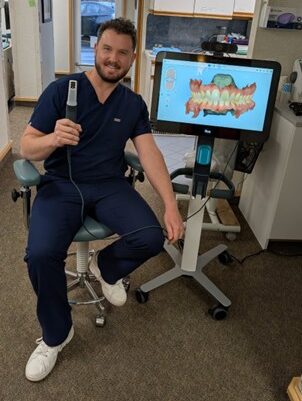
The best time to start Invisalign treatment is now, and the next best time would be to have that discussion with your hygienist or dentist at your next cleaning appointment. Invisalign always starts with a scan. Harbor Lights Dental Care has the latest and greatest intraoral scanner, called the iTero Lumina scanner which has 6 integrated cameras in the wand which take thousands of pictures of your teeth at once, and integrate them together into a digital mosaic that shows your full smile and bite relationship. It is a very impressive sight to be able to visualize your smile first-hand on a screen in front of you, and Dr. Pellegrom and staff are equipped to surf around and show you what can be possible with Invisalign treatment. This scan serves as a digital impression, so there is no need for ‘goopy’ impressions to make models of your teeth. This digital model is also a great medium to show defects on the teeth that may require fillings or crowns.
Other intraoral records taken at the start of orthodontic treatment also include panoramic x-rays which show all your teeth and roots at the start of treatment. The digital impression taken with the iTero Lumina scanner is used to design a comprehensive orthodontic treatment plan which will be organized and presented to you prior to starting treatment. This is also the time where our skilled insurance team will go through all considerations for financing your care, taking into account insurance allowances and your goals for treatment. We have many financing options available as well that make this revolutionary service affordable for everyone. It’s just that easy! Once your Invisalign box and trays are delivered in 3 weeks, the real treatment can begin!
5. The first appointment of Invisalign
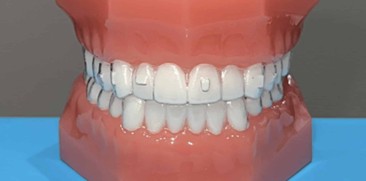
At your Invisalign start appointment, three main things will happen: Attachment placement, Interproximal reduction, Tray and start-kit delivery.
Attachments are specifically shaped ‘buttons’ that are bonded to the sides of your teeth. They are designed so that the Invisalign trays engage the tooth and direct the force where the tooth needs to go. They are tooth colored so they are camouflaged on the tooth surface, and there is no drilling necessary to adhere them onto the tooth. The dental handpiece is only used to trim away excess material around the attachment and smooth rough edges.
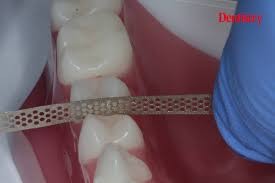
Interproximal reduction is careful buzzing in between the teeth to make more room for teeth to slide past one another into alignment. It is common practice to employ this technique where teeth are crowded together, or to match the upper and lower midlines. There is no numbing required and the process is pain-free and fast!
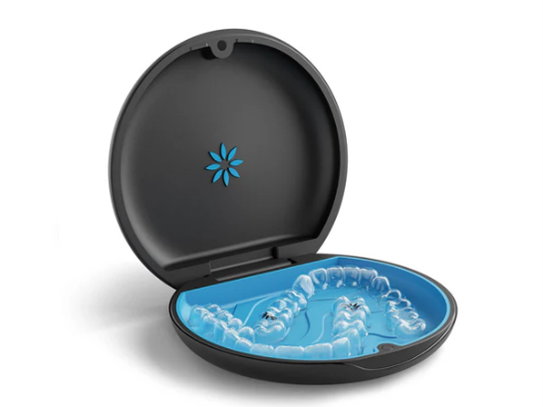
Trays are delivered at doctor prescribed intervals, usually 4 sets of trays at a time or 2 months between office visits to check on movement progress and attachment integrity. Sometimes elastic bands may be indicated to reposition the jaw into an ideal occlusion. Occlusion is the pattern of how teeth come together. You will also receive a carrying case and cleaning instructions for your trays! This is the beginning of a transformational change in how you see yourself in the mirror. Treatment doesn’t stop until you are happy and your teeth are in harmony. That’s the guarantee that Dr. Pellegrom and the staff at Harbor Lights Dental Care provide when you embark on your Invisalign journey.
6. Refinements
Refinements are additional sets of trays to get you from the last step of the initial phase of treatment to an even more desirable outcome. It involves a new scan after attachment removal, followed by a new Invisalign start appointment with the steps outlined above. The key difference with refinements is that these sets of trays are only a one week wear period, meaning that you change to a new set of trays every week instead of every two weeks. All sets of trays are delivered at once, then a final follow up appointment is completed to remove attachments and scan for retainers! A refinement set is not always indicated; sometimes we get it perfectly right with the first set!
7. Retainers
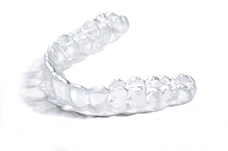
One of the most common questions that comes up during orthodontic consultations is “how long do I need to wear my retainers for?”. There is one simple answer that I learned from one of my mentors Dr. Jason Charnley, and Orthodontist in West Michigan, and that is: “As long as you want straight teeth!”. Dr. Charnley is right—teeth are always on the move. Moving closer together, getting pushed forward over time, and changing dynamically with new functional habits. Retention is extremely important to preserve the movements that have been accomplished orthodontically. One set of retainers is included with Invisalign treatment, but you may choose to order additional sets if desired. Retainers are especially important to wear at night for the first 6 months after Invisalign treatment is completed. This helps to stabilize the bone remodeling that is happening around the tooth roots and prevent large movements from happening down the road.
8. Maintaining your smile
Regular dental appointments are very important to help maintain your dental hygiene and track your progress through the dental treatment. Invisalign does not suspend your regular cleaning schedule with your trusted hygienist at Harbor Lights Dental Care! We take extra care to ensure that your regular cleaning appointments are scheduled in addition to your Invisalign check-ups, and that you have the proper hygiene instruction to keep your teeth healthy and strong throughout your treatment. Our hygienists are specially trained in hygiene techniques and the use of the iTero intraoral scanner to check on progress and ensure that everything is going to plan!
All of these aspects of Invisalign treatment ensure that you can find success aligning your smile here at Harbor Lights Dental Care! If you are interested in learning more about Invisalign treatment, feel free to call and schedule a consultation today! 616-842-2850